Your team leaves with a RAG app that runs.
LLM APIs, embeddings, vector search, retrieval and agents — taught by building them on your engineers' own laptops, against your own documents. Not a deck about what GenAI could do.
- Duration
- 2 hours – 2 days
- Group size
- 10 – 40
- Format
- On-site or virtual
- Taught by
- Som Sankar Naskar
- Output
- A running RAG app
Built in the room, not described on a slide.
Most AI training explains the architecture diagram and stops. This one starts at a terminal. Every concept arrives as something your engineers type, run, break and fix — in the order a real system is assembled, because each piece only makes sense once the one before it works.
No pseudocode. Working code your team keeps, in the language they already write, that still runs on Monday.
Bring a folder of your own policy or product documents. The retrieval they build searches those, so the answer quality is a real signal.
Bad chunking, a stale index, a confident wrong answer, a token bill nobody forecast. Knowing where this breaks is most of the skill.
Five parts, in dependency order.
The numbering is not decoration. Each part needs the one above it working, which is why the RAG build lands fourth and not first.
LLMs and API integration
The first call from their own editor. Messages and roles, system prompts, streaming, temperature, structured JSON output, retries and rate limits — and what a token actually costs, worked out on the whiteboard.
Embeddings and vector search
Turning text into vectors and seeing similarity behave. Cosine distance, dimensions, chunk size and overlap — and a demonstration of how chunking alone decides whether retrieval finds the right paragraph.
RAG architecture
Retrieve, rank, ground, answer, cite. Where each stage fails in production, why a vector store is not a database, and how to tell a grounded answer from a plausible one.
The live mini RAG build Centrepiece
Index your documents, query them, ground the answer, show the citation. Roughly 150 lines, written together, running on every laptop in the room. This is the part people remember, and the part they reuse.
AI agents, honestly
Tool calling, the loop, memory and state, and where an agent is genuinely the right structure — plus the far more common case where a single well-built prompt beats one and costs a fraction as much.
Timings above describe the two-hour version. Longer formats keep the same order and give every participant time to build each stage themselves rather than follow along.
Four things, all of them concrete.
A repository that runs
The RAG application from part four, on their machine, indexed against your documents. Commented, and theirs to extend.
A cost model
What one query costs at your volume, and which of the three knobs moves that number. Enough to sanity-check any GenAI proposal they are handed.
A shortlist of real candidates
We close by looking at your actual work and naming which problems suit this stack and which do not. Most rooms find two or three worth starting.
A calibrated instinct
Having watched retrieval return the wrong chunk once, they stop treating model output as fact. That instinct is the reason to run this in person.
Tell us the hours you have.
The curriculum fits the time, not the other way round. Duration, depth, group size and location are all decided with you before we quote.
The full arc, tightly run. The RAG app is built live with the room following along on their own machines. Best for a leadership team or a first exposure across a wide group.
Same five parts, but every participant builds and debugs their own pipeline rather than following. Adds retrieval evaluation and a proper look at chunking strategies.
Adds guardrails, prompt injection, evaluation harnesses, caching and cost control — the work that separates a demo from something you would let a customer touch.
Everything above, then agents built properly with tools and state, deployment, and a second day spent on one real item from your own backlog.
Anyone who will have to judge an AI proposal.
Developers who write good software and have been asked to add AI to it. Two hours replaces a month of scattered tutorials.
People who approve AI budgets. Building the thing once is the fastest way to stop mistaking a demo for a system.
Agencies and L&D firms who need a practitioner to deliver the technical session while they own the client relationship.
Participants should be comfortable in Python or JavaScript. No machine-learning background is needed, and none of it is assumed.
One instructor, who builds this for a living.
This session is delivered by Som Sankar Naskar personally — not by a rotating pool of trainers, and not by an associate who learned the material to teach it.

Som Sankar Naskar
CTO, GreatKapital · 11+ years building products at scale
Chief Technology Officer at GreatKapital, where he has taken AI agents from prototype into production and built the data pipeline underneath them — the unglamorous half that decides whether any of this survives contact with real volume. Eleven years building products at scale, and several hundred engineers hired and mentored along the way.
Every example in this workshop comes from that work: the architecture calls, the ones he would make differently now, and the costs nobody forecasts until the first invoice arrives. He teaches the judgement rather than the syntax, because the syntax is the part a model will happily write for you.
- Runs AI agents in production as CTO of GreatKapital
- Owns the data pipeline those agents depend on, end to end
- Answers architecture questions from having made the call, not from a slide
- Same person on the enquiry, the agenda and the day itself
Sessions already run.
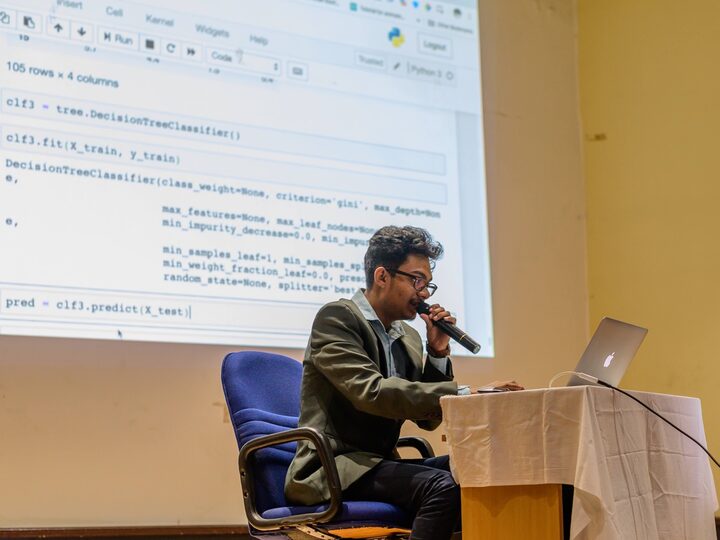
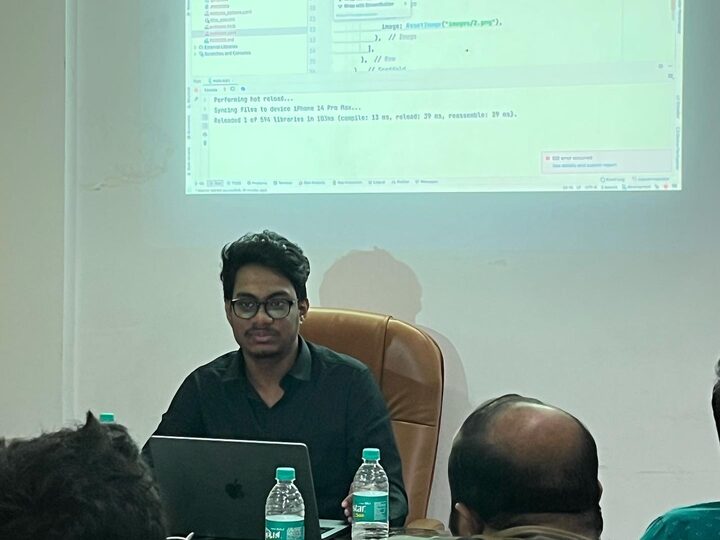
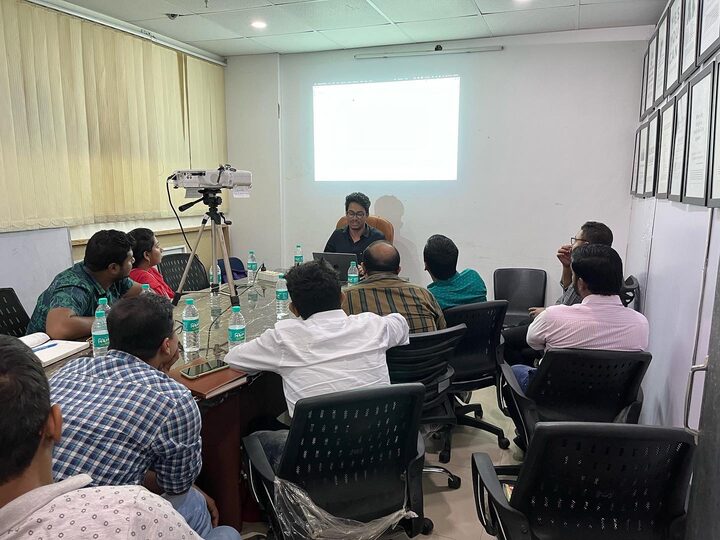
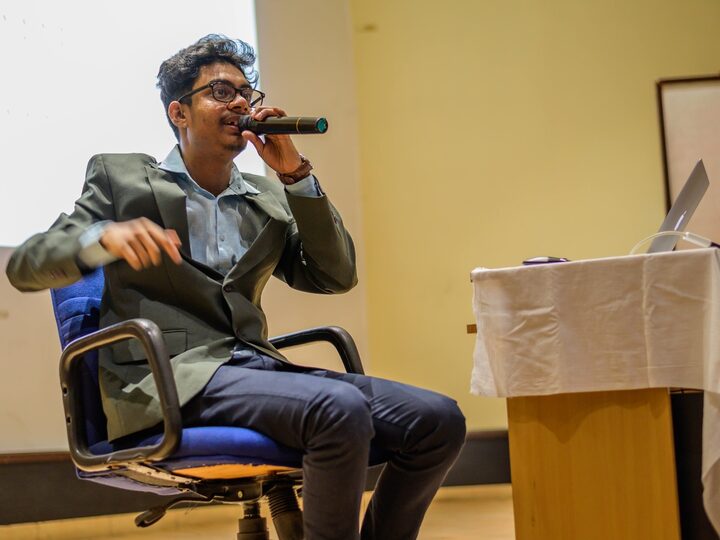
Corporate rooms and campus halls, in India. The common thread is a live editor on the screen rather than a slide about one — the first photograph below is a notebook being written in front of a hall, which is exactly how the RAG build runs in this workshop.
What we need in the room.
- One laptop per participant, with Python or Node already installed
- Wi-Fi that allows outbound HTTPS to model providers
- A projector or large screen
- A folder of your own documents to index — policies, product docs, manuals
- API keys with a pre-funded budget, so nothing waits on your procurement
- A starter repository, dependencies pinned and tested beforehand
- An offline fallback, in case the venue network refuses to cooperate
- A Sodiarc Education certificate of completion for every participant, in their name
- A written summary afterwards, including the candidate problems we identified
We travel to you. On-site anywhere in India — Delhi NCR, Mumbai, Hyderabad, Chennai, Pune and Bengaluru are routine — or delivered virtually where that suits the group better. If your documents cannot leave your network, we run the whole session against a local model instead; mention it on the form and we will plan for it.
Looking for something broader than AI?
The Product Engineering Camp is a different thing: a full day where a batch of 20 to 200 defines a real problem and ships a working product, with AI as one of the tools rather than the subject. This workshop is the technical deep dive; the camp is the product one.
Tell us the room and the hours.
Group size, how much time you can give it, where you are, and what your team already knows. You get an agenda and a quote back within a working day.